 New Zealand
 Australia
 United States
 United Kingdom
 Ireland
 Panels
 Desk Screens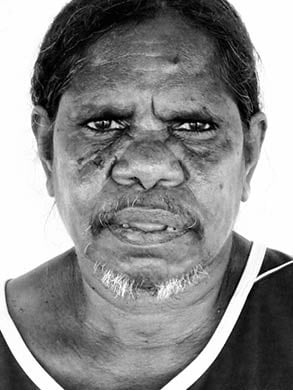
Kathleen Korda
Kathleen Korda
Designs: Durrmu (KK)
Born and educated at the Daly River Mission, Kathleen Korda later lived in Peppimenarti (NT) where her mother and grandmother taught her to weave baskets, string bags and fish nets.
Born and educated at the Daly River Mission, Kathleen Korda later lived in Peppimenarti (NT) where her mother and grandmother taught her to weave baskets, string bags and fish nets.
Susan Marawarr
Susan Marawarr
Designs: Wak Wak
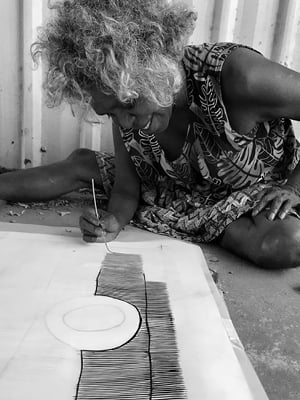
Susan Marawarr (b. 1967) is a printmaker, sculptor, weaver and bark painter from Maningrida (NT). She has exhibited at Gallery Gabrielle Pizzi, Melbourne (2011), and Suzanne O’Connell Gallery, Brisbane (2018).
Her work is in the Art Gallery of Western Australia, Museum of Contemporary Art and the National Gallery of Australia. Wak Wak features rarrk (cross-hatching) and refers to the crow totem ancestor, Djimarr. Today Djimarr exists as a submerged rock at the bottom of Kurrurldul Creek, south of Maningrida.
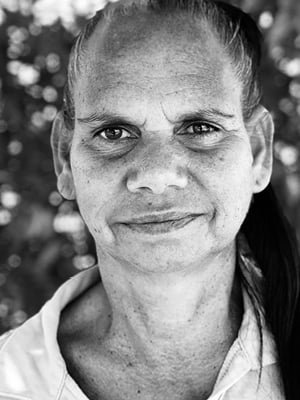
Annunciata Nunuk Wilson
Annunciata Nunuk Wilson
Designs: Syaw (Fish Net)
Annunciata Nunuk Wilson of Peppimenarti (NT) was born c. 1970, the eldest daughter of the esteemed artist Regina Pilawuk Wilson. Annunciata paints durrmu (dot body painting) and has recently been experimenting with sun mat, basket stitch and merrepen leaf designs.
Syaw (Fish Net) evokes nets traditionally woven with pinbin (bush vine) by the women and men of Peppimenarti to capture fish and crayfish from freshwater creeks and rivers.
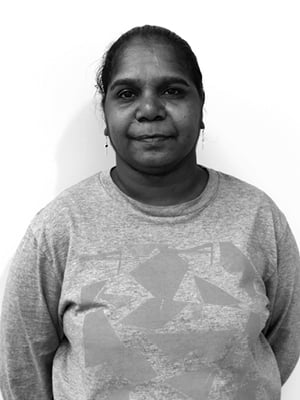
Lee-Anne Williams
Lee-Anne Williams
Designs: Water Levels
Lee-Anne Williams, from Fitzroy Crossing (WA), is of the Bunuba and Wangkatjunka lanuage groups. She began her career painting boab nuts, moving onto screen and lino printing on textiles before becoming a founding member of the 2017 Design Within Country fashion project. Water Levels references the marks that remain on the rocks of the Fitzroy River, after flood water levels rise and fall.
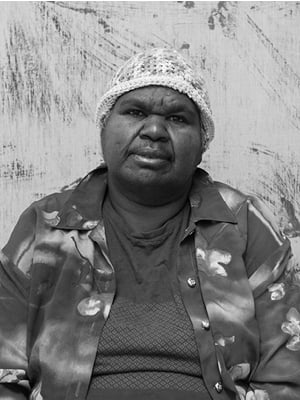
Jean Ngawarraye Long
Jean Ngawarraye Long
Designs: Native Seeds
Jean Ngwarraye Long was born in 1963 and has lived in Ampilatwatja (NT) all her life. She has exhibited at ArtKelch, Germany (2015), Flinders Lane Gallery, Melbourne (2018), Suzanne O’Connell Gallery, Brisbane (2018), and was also a finalist in the 40th Alice Art Prize, Alice Springs, (2018).
Native Seeds represents the process of harvesting edible seeds from trees in the Ampilatwatja region. The seeds are used to create a dough, similar to damper which is cooked on hot coals.
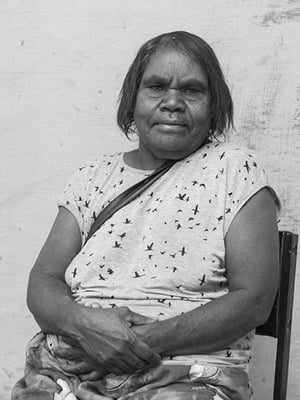
Rose Ngwarraye Ross
Rose Ngwarraye Ross
Designs: Sugarbag Dreaming
Rosie Ngwarraye Ross (1951-2023) was born near Amaroo Station, Northern Territory. Rosie depicted the bush medicine plants and wild flowers from around her country near Ampilatwatja. She had a bold expressive style and often omitted the sky from her compositions, combining both aerial and frontal views.
Sugarbag is a name used for both the honey made by the native bees and also for the sweet nectar that comes from the big yellow flowers of the ‘tarrkarr’ trees.
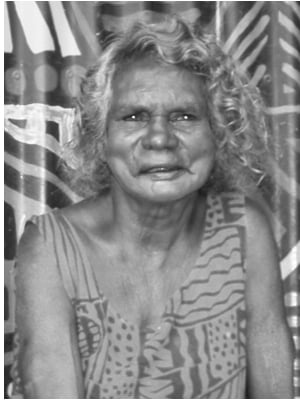
Jean Baptiste Apuatimi
Jean Baptiste Apuatimi
Designs: Jilamara
Tiwi artist Jean Baptiste Apuatimi (1940-2013) is internationally acclaimed as a painter, carver and printmaker. Her work is held in public and private collections all over the world, including the British Museum (UK), Seattle Museum of Art (USA) and National Museum of Women in the Arts (USA).
Jilamara is a Tiwi word that refers to the ochre patterning traditionally painted on the bodies of dancers and on carved poles during Pukumani ceremonies. Jilamara is unique to Tiwi Islanders.
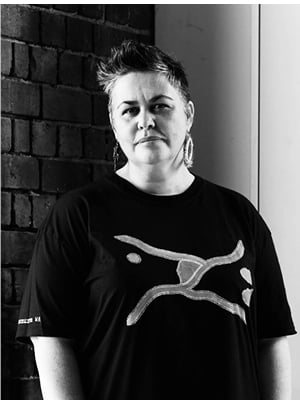
Lisa Waup
Lisa Waup
Designs: Oneness and Renewed
Lisa is a mixed-cultural First Nations artist and curator from Narrm (Melbourne). With a deep connection to the symbolic power of materials, her work reflects her personal experiences, family history, country, and broader historical narratives.
Oneness represents the many aspects of self, centred around identity and belonging, and translates to a state of being unified or whole, comprising two or more parts.
Renewed represents the rains after the dryness of summer and how the rain runs away from country after being baked for weeks by intense heat with little respite.
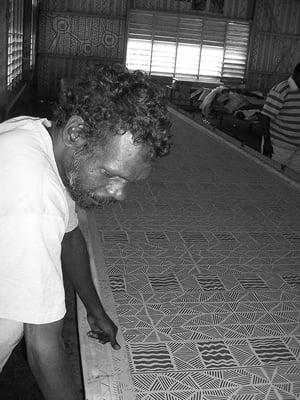
Osmond Kantilla
Osmond Kantilla
Designs: Pandanus
Osmond Kantilla (b. 1966) is a master screen printer from the Tiwi Islands. His country is Wurruranku and his skin group is Marntimapila (Stone).
His work is held in numerous collections, including the National Museum of Australia, the Powerhouse Museum and the Art Gallery of South Australia. Pandanus represents the pointy leaves of the pandanus plant. Osmond Kantilla created this design in memory of his father.










 Back to top